Development and capital

When Capital Moves On

When development outpaces demand and infrastructure, capital may seek a new frontier while the costs remain with the community.

A recurring cycle

Arkadiynight / Wikimedia Commons · CC BY-SA 4.0 · cropped and resized

The development mechanism

Growth can move faster than the systems that sustain it.

The sequence begins when land and development capital respond to a destination's appeal. New beds, venues and services multiply. If their combined capacity grows faster than demand, trading becomes more difficult; if roads, water, waste systems and workforce housing lag, the cost of growth appears in daily life. Capital may then pursue the next frontier while the obligations created by development remain.

A recurring cycle

  1. 01

    Attention

    Investment follows a destination's growing appeal.

  2. 02

    Oversupply

    Commercial capacity can grow faster than demand.

  3. 03

    Pressure

    Margins, infrastructure and daily life come under strain.

  4. 04

    Displacement

    Development interest shifts towards less-developed districts.

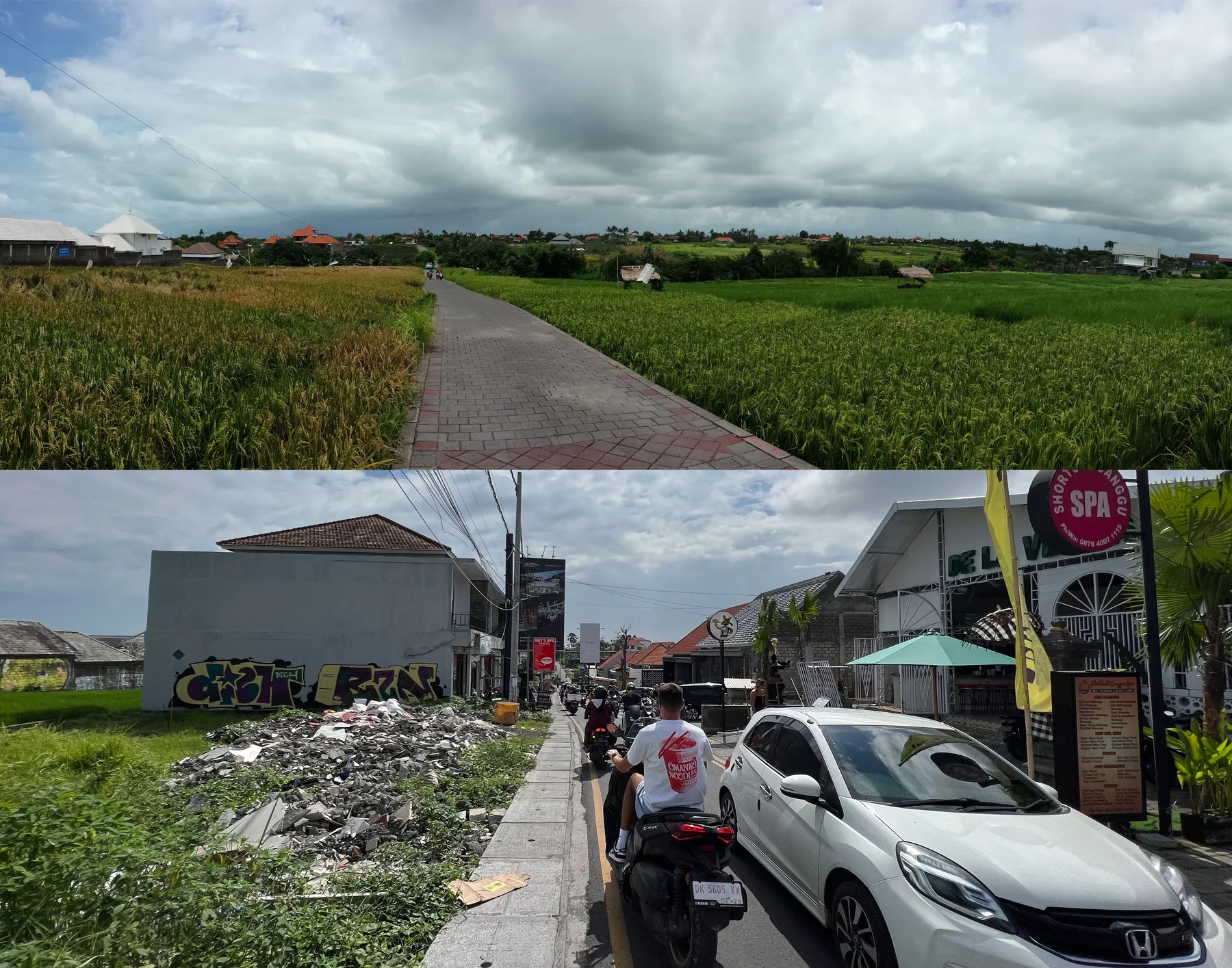
A landscape under pressure · Canggu, Bali

The frontier does not stay a frontier.

The Canggu Shortcut photographed in 2013 and 2023. The comparison shows physical change at one location: fields give way to buildings and a quiet road becomes a busy corridor. It is not, by itself, a measurement of investment flows or a complete account of local change.

A photographic comparison of the Canggu Shortcut in 2013 and 2023
2013 / 2023Arkadiynight / Wikimedia Commons · CC BY-SA 4.0 · resized

The west-coast corridor

A frontier moves north

Kuta, Legian, Seminyak and Canggu are connected parts of Bali's west-coast tourism geography. The sequence below is an interpretation of changing development pressure, not a measured record of capital moving from one district to the next. Older centres continue to trade and attract investment.

01

Kuta

An established beach destination and an early centre of Bali's international tourism. Research describes its appeal to visitors from the early 1970s and examines the carrying capacity of its tourism businesses.

Kuta zoning and carrying capacity study
02

Legian

The corridor linking Kuta and Seminyak brings hotels, shops, bars and clubs into the same street network. A road and pedestrian infrastructure study describes congestion and missing or obstructed pedestrian facilities.

Jalan Legian infrastructure study
03

Seminyak

As part of the connected Kuta–Legian–Seminyak area, hospitality and commercial activity share roads and public space with daily local movement. Intensification makes mobility and the quality of the street network part of the economic equation.

Kuta Raya visitor mobility study
04

Canggu

Tourism-oriented accommodation and businesses have transformed village space and land use. A study of Canggu residents reports concerns including rising prices, congestion, noise and changes to community life, alongside opportunities for some local households.

Canggu residents and overtourism study

Canggu · the price–income gap

Local wages. International prices.

Canggu illustrates an arbitrage: an enterprise can pay local wages and land costs while pricing its offer for visitors with European or other overseas purchasing power. When housing, food and services follow that spending power but local earnings do not, people who work in a community can find it increasingly difficult to live and participate in it. In a study of Canggu, residents described restaurant prices as unrealistic for local people and reported rising land and rental prices. Foreign participation is not itself the problem; the economic question is who owns the businesses, who shares in the returns and whether local wages, opportunities and access keep pace.

Canggu residents and overtourism study

Other geographies, related pressures

The pattern is not confined to one coast.

Bingin, Uluwatu and Ubud have their own tourism histories. They are not presented here as successive stops on the west-coast route. Their experience raises related questions about land, cultural stewardship and who captures economic value.

Bingin

Cliffside tourism brings economic activity into a constrained coastal setting. In July 2025, Balinese authorities began removing 48 structures at Bingin which they said violated land-use rules. The episode illustrates both planning enforcement and the exposure of people whose livelihoods depend on the affected businesses.

Bali provincial enforcement report, 2025

Uluwatu

Surfing and the coastal environment support a significant visitor economy. A 2014 surf-tourism valuation identified the risk that development could damage the coastal qualities on which that economy depends.

Uluwatu surf tourism valuation

Ubud

Cultural and wellness tourism creates opportunities as well as questions about participation and value retention. Ethnographic research into wellness tourism reports that many interviewees did not share equally in its benefits, citing foreign dominance, economic leakage and isolated enclaves.

Research on wellness tourism and local equity

What remains

The cost is local.

Communities may be left managing congestion, infrastructure pressure, weakened businesses and changes to land use, even as new capital moves elsewhere.

The H-TEM response

Match growth to capacity.

Coordinate commercial supply, workforce provision and infrastructure with demand, then revisit those assumptions as conditions change.

Explore the ratios

Development pressure is not inevitable: its effects depend on planning, infrastructure, land use and the choices made by communities, investors and governments.